
Saturday, May 6, 2017

SAARC Satellite GSLV-F09 / GSAT-9

GSLV-F09 launches 2230 kg South Asia Satellite GSAT-9 into a Geosynchronous Transfer Orbit (GTO). GSLV-F09 mission is the eleventh flight of India’s Geosynchronous Satellite Launch Vehicle (GSLV) and its fourth consecutive flight with the indigenous Cryogenic Upper Stage (CUS).   The vehicle is designed to inject 2 - 2.5 ton class of satellites into GTO. The overall length of GSLV-F09 is 49.1 m.
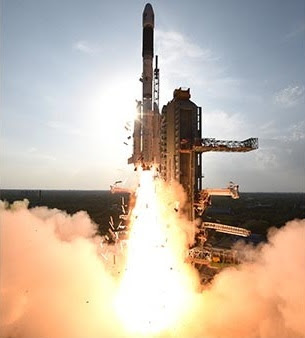
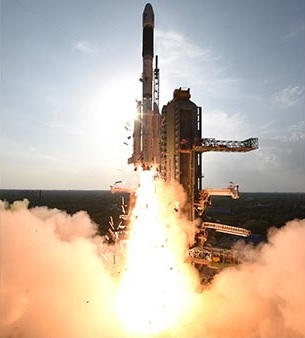
South Asia Satellite GSAT-9 is a Geostationary Communication satellite realised by India. The primary objective of GSAT-9 is to provide various communication applications in Ku-band with coverage over South Asian countries.

GSAT-9 is configured around the ISRO’s standard I-2K bus. With lift off mass of 2230 kg the main structure of the satellite is cuboid in shape built around a central cylinder. GSAT-9 carries communication transponders operating in Ku-band.

The two solar arrays of GSAT-9 consisting of Ultra Triple Junction solar cells generate about 3500 Watts of electrical power. Sun and Earth sensors as well as gyroscopes provide orientation  reference for the satellite. The Attitude and Orbit Control System (AOCS) of the satellite maintains it’s orientation with the help of momentum wheels, magnetic torquers and thrusters. The satellite’s propulsion system consists of a Liquid Apogee Motor (LAM) and chemical thrusters using liquid propellants for initial orbit raising and station keeping. The satellite also carries plasma thrusters, assisting in station keeping.

Launch Mass: 2230 kg
Mission Life:12 years
Power: 3500 Watts
Launch Vehicle: GSLV-F09 / GSAT-9
Type of Satellite: Communication
Manufacturer: ISRO
Application: Communication
Orbit Type: GSO
payloads: Ku-band Transponders
Read More »

Thursday, May 4, 2017

Cryogenic Engines

A cryogenic rocket engine is a rocket engine that uses a cryogenic fuel or oxidizer, that is, its fuel or oxidizer (or both) are gases liquefied and stored at very low temperatures.


A cryogenic rocket engine reuires a high mass flow rate to produce more thrust.At room temperature and pressure, both are in gaseous state. Hypothetically, if propellants had been stored as pressurized gases, the size and mass of fuel tanks themselves would severely decrease rocket efficiency. Therefore, to get the required mass flow rate, the only option was to cool the propellants down to cryogenic temperatures (below -183 °C [90 K], -253 °C [20 K]), converting them to liquid form. Hence, all cryogenic rocket engines are also, by definition, either liquid-propellant rocket engines or hybrid rocket engines.

The combination of liquid hydrogen (LH2) fuel and the liquid oxygen (LOX) oxidizer is one of the most widely used.Methane and nitrogen are also used in cryogenics.This is used in upper stages of the rocket .The fuel is stored in very low temperatures and burn at plus hundred degrees few centimeters below.

India has two cryogenic engines developed by ISRO

CE-7.5 uses Staged combustion and produces 73KN thrust
CE-20 uses Gas-generator  and produces 200KN thrust


The C25 stage is the most powerful upper stage developed by ISRO and uses Liquid Oxygen (LOX) and Liquid Hydrogen (LH2) propellant combination.  The stage carries 27.8 tons of propellants loaded in two independent tanks.The cryogenic stage designated as C25 was tested for a flight duration of 640 seconds at ISRO Propulsion Complex (IPRC) in Mahendragiri.

The development of C25 cryogenic stage began with the approval of GSLV MKIII, the next generation launch vehicle of ISRO, capable of launching 4 ton class spacecraft in Geosynchronous Transfer Orbit (GTO). The vehicle consists of two solid strap-on motors (S200), one earth storable liquid core stage (L110) and the cryogenic stage upper stage (C25).
Read More »

Tuesday, January 17, 2017

India’s indigenous trainer aircraft maiden flight


HTT-40 (Hindustan Turbo Trainer-40) is a new basic training aircraft being developed by Hindustan Aeronautics Limited (HAL) for the Indian Air Force (IAF) took to the skies for the first time on May 31, 2016 and completed a basic flight of about 25 minutes without glitches.Stating that the aircraft was piloted by an HAL test pilot who did not try out any specific manoeuvres, sources said, it had completed the high-speed taxi trials a few days ago.The low-speed trials were completed in March 2016 before which about 40 engine ground runs were completed .The new aircraft will replace the ageing fleet of HAL HPT-32 Deepak trainers that are in service with the IAF.


The aircraft will be primarily used for
Basic flying training
Aerobatics
Instrument Flying
Navigation
Night Flying
Close formation

Design and features

The HTT-40 will be a fixed-wing aircraft incorporating an all-metal airframe design. It will feature a bubble canopy, T-tail configuration and a retractable tricycle landing gear system with a steerable nose wheel.

It will have a maximum take-off weight of 2,800kg and can be configured to carry a gun, rockets and bombs to perform light combat and counter-insurgency missions.

Speed: 450 Km/hr
Range: 1000 KM
Engine Thrust: 950 SHP
Cockpit: Tandem seating, Air conditioned cockpit
Modern Aircraft System: All metal, FADEC control Turbo Prop trainer aircraft with Zero-Zero ejection seats and Multifunction displays

Engineering notes
An oleo strut is a pneumatic air–oil hydraulic shock absorber used on the landing gear of most large aircraft and many smaller ones. This design cushions the impacts of landing and damps out vertical oscillations.

An oleo strut consists of an inner metal tube or piston, which is attached to the wheel axle, and which moves up and down in an outer metal tube that is attached to the aeroplane frame. The cavity within the strut and piston is filled with gas (usually nitrogen or sometimes air ) and oil (usually hydraulic fluid), and is divided into two chambers that communicate through a small orifice.

During landing the piston slides up and down. It compresses the gas, which acts as a spring, and forces oil through the orifice, which acts as a damper. A tapered rod ( metering pin ) is used on some designs to change the size of the orifice as the piston moves, providing greater resistance as compression of the strut increases. Additionally, a check valve is sometimes used to uncover additional orifices so that damping during compression is less than during rebound.

Nitrogen is usually used as the gas instead of air, since it is less likely to cause corrosion. The various parts of the strut are sealed with O-rings or similar elastomeric seals, and a scraper ring is used to keep dust and grit adhering to the piston from entering the strut.
Read More »

Worlds cheapest computer 350 Rupees only /-


Pi Zero is a tiny device and contains the first generation Raspberry Pi’s BCM2835 chip, safely overclocked to 1GHz. Pi Zero comes with 512MB RAM ,a MiniHDMI port and two Micro USB ports, including one for power. It runs Linux, and runs all the programs and applications any other Pi will—including Python, Sonic Pi, Java, a web browser, and much more. You can run a media center, teach programming with it, learn to make music, or embed it in a project.

Full features
Broadcom BCM2835 application processor
1GHz ARM11 core (40 percent faster than Raspberry Pi 1)
512MB of LPDDR2 SDRAM
Micro-SD card slot
MiniHDMI socket for 1080p60 video output
Micro-USB sockets for data and power
An unpopulated 40-pin GPIO header
Identical pinout to Model A+/B+/2B
An unpopulated composite video header
“Smallest ever” form factor (65mm x 30mm x 5mm)

Engineering notes
Moore’s law is the observation that the number of transistors in a dense integrated circuit doubles approximately every two years. The observation is named after Gordon E. Moore, the co-founder of Intel and Fairchild Semiconductor.

His prediction proved accurate for several decades, and the law was used in the semiconductor industry to guide long-term planning and to set targets for research and development. Advancements in digital electronics are strongly linked to Moore’s law: quality-adjusted microprocessor prices, memory capacity, sensors and even the number and size of pixels in digital cameras.

Moore’s is a observation and natural law.
Read More »

This company delivers goods to space !!!


SpaceX’s Falcon 9 rocket will launch the Dragon spacecraft to low Earth orbit to deliver critical cargo to the International Space Station (ISS) for NASA.The recent launch on July 17 was successful.

Falcon 9
Falcon 9 is a two-stage rocket designed and manufactured by SpaceX for the reliable and safe transport of satellites and the Dragon spacecraft into orbit. As the first rocket completely developed in the 21st century, Falcon 9 was designed from the ground up for maximum reliability. Falcon 9’s simple two-stage configuration minimizes the number of separation events — and with nine first-stage engines, it can safely complete its mission even in the event of an engine shutdown.

Dragon Spacecraft
This is the ninth mission by SpaceX under NASA’s Commercial Resupply Services contract. Among the
almost 5,000 pounds of supplies, equipment and science research Dragon will carry is the first of two
international docking adapters, which will allow Boeing’s CST-100 Starliner and SpaceX’s Crew Dragon
spacecraft to dock to the station when transporting astronauts in the near future as part of NASA’s
Commercial Crew Program.

ISS Capture
About two days after launch, International Space Station crew members will use the station’s 57.7-foot
(17.6-meter) robotic arm to reach out and capture the Dragon spacecraft and attach it to the station.

Return Flight
Dragon will return to Earth after more than a month stay at the ISS. Approximately five hours after
Dragon leaves the station, it will conduct its deorbit burn, which lasts up to 10 minutes. It takes about 30
minutes for Dragon to reenter the Earth’s atmosphere and splash down in the Pacific Ocean off the
coast of Baja California.
Read More »

China completes world’s largest radio telescope


Installation was completed on the world’s largest radio telescope , Five-hundred-meter Aperture Spherical Telescope (FAST) in Pingtang County, southwest China’s Guizhou Province ,which consists of 4,450 panels fitted into the center of the big dish.This telescope is bigger than Puerto Rico’s Arecibo Observatory, which is 300 meters in diameter.

“As the world’s largest single aperture telescope located at an extremely radio-quiet site, its scientific impact on astronomy will be extraordinary, and it will certainly revolutionize other areas of the natural sciences,” said Nan Rendong, chief scientist with the FAST Project.

The telescope site was a remote location which housed only 65 people , who were relocated .An additional 9,110 people living within a 5 km radius of the telescope were relocated to create a radio-quiet area.

The reflector is made of perforated aluminum panels supported by a mesh of steel cables hanging from the rim.FAST’s surface is made of 4450 triangular panels, 11 m (36 ft) on a side,in the form of a geodesic dome. Actuators underneath make it an active surface, pulling and pushing on joints between panels, deforming the flexible steel cable support into a parabolic antenna aligned with the desired sky direction.Its working frequency range of 70 MHz to 3.0 GHz.
Read More »

Microscope for 50 rupees ?


Here is an ultra-low-cost origami-based approach for large-scale manufacturing of microscopes, specifically demonstrating brightfield, darkfield, and fluorescence microscopes. Merging principles of optical design with origami enables high-volume fabrication of microscopes from 2D media. Flexure mechanisms created via folding enable a flat compact design. Structural loops in folded paper provide kinematic constraints as a means for passive self-alignment. This light, rugged instrument can survive harsh field conditions while providing a diversity of imaging capabilities, thus serving wide-ranging applications for cost-effective, portable microscopes in science and education.

Foldscope is an origami-based print-and-fold optical microscope that can be assembled from a flat sheet of paper. Although it costs less than a dollar in parts, it can provide over 2,000X magnification with sub-micron resolution (800nm), weighs less than two nickels (8.8 g), is small enough to fit in a pocket (70 × 20 × 2 mm3), requires no external power, and can survive being dropped from a 3-story building or stepped on by a person.


Advantages:

Low cost ( just 50 rupees )
Portable (weighs less than 10 gm , is small enough to fit in a pocket (70×20×2 mm3) )
Rugged as it just paper and doesnot break
Easy to assemble( you can assemble in less than 10 minutes )
Various imaging modalities (brightfield, darkfield, fluorescence, lens-array)
Read More »